
The use of annual profections as a predictive technique dates back at least to the early Hellenistic period, during which astrologers synthesized Babylonian, Egyptian, and Greek traditions, giving birth to “horoscopic” astrology. The term “horoskopos” (Greek: ὡρόσκοπος), meaning “marker” or “observer” (skopos) of the hour (hora) of birth, is the ancient root from which our modern word “horoscope” derives. Some astrologers see a close connection between the Myth of Er, described by Plato, and the horoskopos as symbolizing the precise moment chosen by the soul, with the aid of its daimon, to reincarnate, based on the soul’s current state of development and what it still needs to learn.

Conceptually, profections are related to the concept of “time lords” or chronocrators. The basic idea is that the human lifespan can be divided into various periods during which certain zodiacal signs, chart points, and planetary bodies will be particularly active and influential in the life of the native. Which planet or zodiacal sign will be regarded as a time lord depends on the predictive method being utilized by the astrologer. Several distinct but related predictive techniques evolved in the early centuries of Hellenistic astrology.
Pythagoras of Samos (570 BCE – 490 BCE) developed a philosophical theory based on the premise that “all things are numbers.” He attempted to understand and explain the universe through mathematical relationships and geometric proportions. His number theory influenced ancient astrological timing techniques in specific, structural ways: through harmony, whole‑number ratios, cosmic cycles, and the idea that time itself is a numerical, musical, and geometric expression of cosmic order.
Pythagorean doctrine held that certain whole‑number ratios produce harmony. We see this influence in the astrological theory of aspects in which 1/2 of a circle produces an opposition aspect; 1/3, a trine; 1/4, a square; and 1/6, a sextile. Note that 1/5 is a ratio of whole numbers, but it is not harmonically ordered; astrologers consider 1/5 to be a ratio of aversion or inconjunction.
Ancient astrologers assigned a specific whole number of “minor” years to the Sun, Moon, and visible planets. The lesser or minor years of the planets were expressed as whole numbers based on the synodic cycle of the planet in relation to the Sun, the giver of life in the universe. Synodic cycle refers to the amount of time it takes for a celestial body to return to the same relative position with respect to the Sun as seen from Earth.
The Sun was assigned 19 minor years (6,939.6 days), which is the Metonic cycle of the Moon, discovered by Meton of Athens in 432 BCE. Every 19 years, the phases of the Moon recur on the same days of the solar year. Specifically, every 19 solar years = 6939.6 days, and every 235 synodic months (lunar cycles) = 6939.7 days, so that 19 solar years constitute almost exactly 235 synodic months. The Metonic cycle was used to create accurate calendars and predict the correct dates of the full moons.
While the Sun’s minor or lesser period was based on the Metonic cycle, the Moon’s minor years were based on the observation that 309 lunation cycles constitute 25 solar years. The duration of the lunation cycle is 29.53059. Multiplying by 309 cycles: 29.53059 days x 309 cycles = 9124.93231 days, which divided by 25 years = 364.998 days, or almost exactly 365 days in the 365-day calendar.
In addition to the minor (lesser) periods assigned to each luminary and planet, astrologers assigned major or greater periods to each. Greater periods of the visible planets were the sum total of the so-called Egyptian terms or bounds of a particular planet in all twelve signs of the zodiac. The ancients used a different logic for the luminaries, the Sun and the Moon, which were regarded as sources of light and life.
The Sun, clearly the most powerful luminary and celestial body in the heavens, was assigned the longest major period, a total of 120 years. We find this value repeated in many ancient cultures, for example, in the Book of Genesis of the Old Testament (Genesis 6:3, King James version: “And the Lord said, My spirit shall not always strive with man, for that he also is flesh: yet his days shall be an hundred and twenty years“) and in the Vedic tradition, where the maximum lifespan of the Vimshottari Dasa system is 120 years. In the Pythagorean system, 120 = 5 x 4 x 3 x 2 x 1, and 120 is the smallest whole number divisible by 1, 2, 3, 4, 5, and 6.
The Moon was given 108 years, twelve less than the 120 major years assigned to the Sun, possibly because the Moon is closely linked to the female cycles of menstruation and gestation. Twelve synodic lunar cycles (29.53 days) x 9 = 265.77 days, almost exactly 266 days, which the ancients regarded as the number of days in the period from conception to birth of a baby. Thus, 12 synodic months x 9 months = 108 synodic months, which are the basis for the greater years of the Moon, being symbolically analogous to the conception-to-birth period that precedes parturition. In Jyotisha, there are 27 Nakshatras, each of which is divided into 4 padas: 27 x 4 = 108.
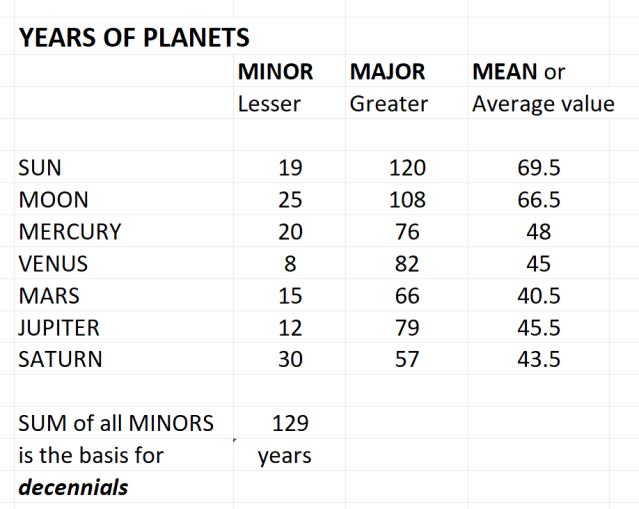
Here is a summary of the rationale for the MINOR YEARS or LESSER PERIODS:
Sun: 19-year metonic cycle.
Moon: 25 years = 309 lunations.
Mercury: 20 years = 63 synodic cycles.
Venus: 8 years = 5 synodic cycles.
Mars: 15 years = 7 synodic cycles.
Jupiter: 12 years = 11 synodic cycles.
Saturn: 30 years = 29 synodic cycles.
As noted above, 19 + 25 + 20 + 8 + 15 + 12 + 30 = 129 minor years in total. This sum becomes the basis of the timing system of decennials (planetary “decades”), which is found in early texts such as that of Critodemus in the 2nd century BCE. Instead of minor years, decennials take the numerical values of the planetary minor years as durations in months. Each cycle of 129 months is regarded as a “decennial” or planetary “decade” since 129 months (divided by 12 months in a year) equals 10.75 (10 years plus an additional 9 months). Each planetary “decade” is governed by one of the seven visible planets in the order in which they appear in the birth chart, usually starting with the sect Light, unless it is cadent or otherwise too weak to function as the appropriate starter or “apheta” of the sequence. The method is quite similar to the dasa systems of Jyotisha. For further details, see https://horoscopes.astro-seek.com/decennials-traditional-astrology-calculator and https://www.youtube.com/watch?v=CySlwSH78dI.
The idea of “apheta,” a planet or point that starts a journey around the birth chart, is fundamental to Hellenistic astrology. In longevity calculations, a life-affirming significator, called the apheta (ἀφέτης) or “starter,” as in a race, is viewed as being sent out or released to be carried by the primary motion of the sky to the position of the “destroyer” or “anairetes” (ἀναιρέτης), a planet or point capable of destroying the life of the native.
The ancient method of annual profections bears a resemblance to aphesis, but a closer look at the language used to describe it suggests that profections were viewed more as a numerological analogy than a process of sending out or releasing a planet or point to advance to another significant position in the birth chart. Given the principle of “as above, so below,” the idea behind annual profections is that the zodiac sign that is first to rise governs the first year of life, the sign that is second to rise governs the second year of life, and so on around the birth chart.
In his Arcana Mundi: Antologia del pensiero astrologico antico (1995), Giuseppe Bezza argues that this ancient timing technique of “profections” is specifically related to the concept of completion or bringing to an end (perfecting) a certain number of years of life (solar revolutions from the moment of birth). Thus, for example, in the 5th year of life (age 4), the native has completed (perfected) 4 years of life, or 4 solar revolutions since the moment of birth, which is analogous to the zodiacal sign in the 5th place from the ascendant.
Bezza suggests that the original intended term was perfectio (meaning “completion” or “ending,” from the Latin perficere, “to bring to an end”), and that the shift in translation occurred due to a scribal error: the Latin scribal abbreviation for per- (ꝑ) being visually misread as the abbreviation for pro- (ꝓ), leading to the corruption of “perfectio” into “profectio” (from the Latin verb proficere, meaning “to advance”). In other words, if we wish to be consistent with the original language and thinking of the ancient astrologers, we should be calling them annual “perfections.”
Bezza buttresses his argument by pointing out that the Latin word perfectio aligns much more closely with the original Greek and Arabic concepts of this predictive technique. It corresponds to the Arabic term al-intihāʾ (completion; muntha in the Jyothish Tajika tradition) and Ptolemy’s use of the phrase syntelioumenou zōdiou (“sign reached in completion”). Martin Gansten in his Annual Predictive Techniques (2020) appears to be in agreement with Bezza’s analysis. Bezza and Gansten make a compelling case that Hellenistic and medieval Arabic and Persian astrologers conceived of “profections” as indicating the “sign being reached at the end” of a certain age or number of years of life.
Gansten agrees that Ptolemy’s phrase synteloumenou zōdiou refers to the sign “being brought to completion,” reinforcing that the technique concerns the end of a period rather than the beginning of a release. On page 38, he summaries Bezza’s research as follows:
“… the original Latin translation from the Arabic was perfectio, in the sense of a motion being concluded or completed, and that profectio is the result of a misreading …”
If we wish to faithfully practice the ancient Hellenistic technique of “profections,” we should be calling them “perfections” and viewing them not as an example of “aphesis” (sending out, releasing) but rather as an indication of completion, that is, which zodiac sign is analogous to the age that has not yet been completed (perfected) by the native in a particular year according to its order in the sequence of signs measured from the Ascendant. In other words, the focus of perfections is not about a planet “advancing” but rather about the “completion” of a cycle or the reaching of a specific point in a predefined age sequence. In aphesis, the astrologer must carefully analyze the chart to determine which planet or point is most suitable to be the starter of a journey. In perfections, the focus is on the end point, that is, which zodiacal sign corresponds to the whole number of years the native has just completed and the incomplete year that the native is currently experiencing. The difference may appear subtle, but it gives us a glimpse into the minds of the ancient astrologers and how they actually thought about their predictive techniques.