
In his horary charts William Lilly made use of Ptolemy’s observation in the Tetrabiblos that “sometimes, also, among the signs that ascend slowly the sextile aspect destroys, when it is afflicted, and again among the signs that ascend rapidly, the trine” (p.283, Loeb edition).
In other words, Ptolemy observed that the temporal relationship between zodiacal signs (how long they take to rise) modifies the interpretation of the spatial relationship between the planets that occupy those signs (the geometric planetary aspects). In this way, the rising speed of the signs alters the effective harmony of the softer aspects. We cannot assume that sextiles and trines are universally favorable or harmonious. If one or both of the planets in a geometric sextile or trine are afflicted, then the sextiles in signs that rise slowly and the trines in signs that rise rapidly behave destructively.
William Lilly extended Ptolemy’s principle to squares in signs that ascend either slowly or rapidly, thereby becoming more advantageous and harmonious in their effect. One might say that spatial squares in signs of slow ascension act like temporal trines and in signs of rapid ascension, like temporal sextiles. Oppositions are not affected by ascensional times because the signs are 180° apart, and their rising times are symmetrical. Even if one sign rises fast and the other slowly, the total rising time of the pair is always the same.
The bottom line is that zodiacal aspects, measured spatially as arcs along the ecliptic circle (the apparent path of the Sun around the Earth), cannot be interpreted in isolation. Both Ptolemy and Lilly tell us that the effect of spatial zodiacal aspects depends on the condition of the planets involved and the ascensional times of the signs they occupy. To interpret an aspect, we must always consider at least three factors: (1) space (the arc between planets along the ecliptic circle); (2) time (the rising times of the signs involved, which indicates how rapidly or slowly the aspect can be perfected by primary motion); and (3) the condition of the planets (their state of affliction or bonification).
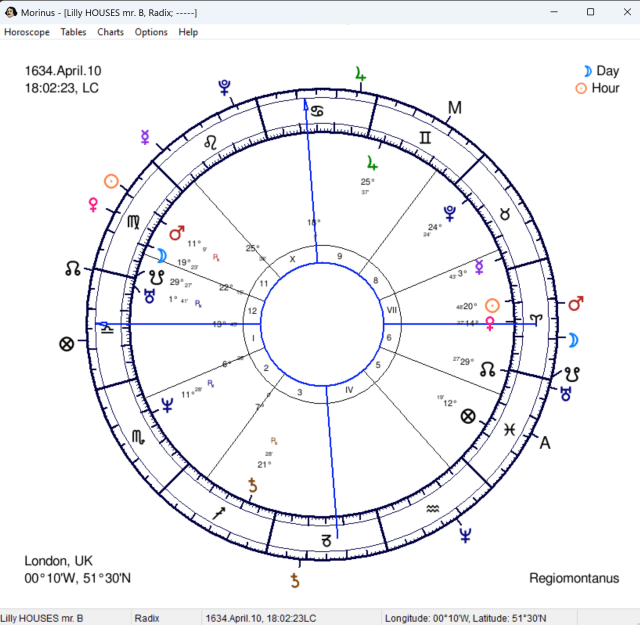
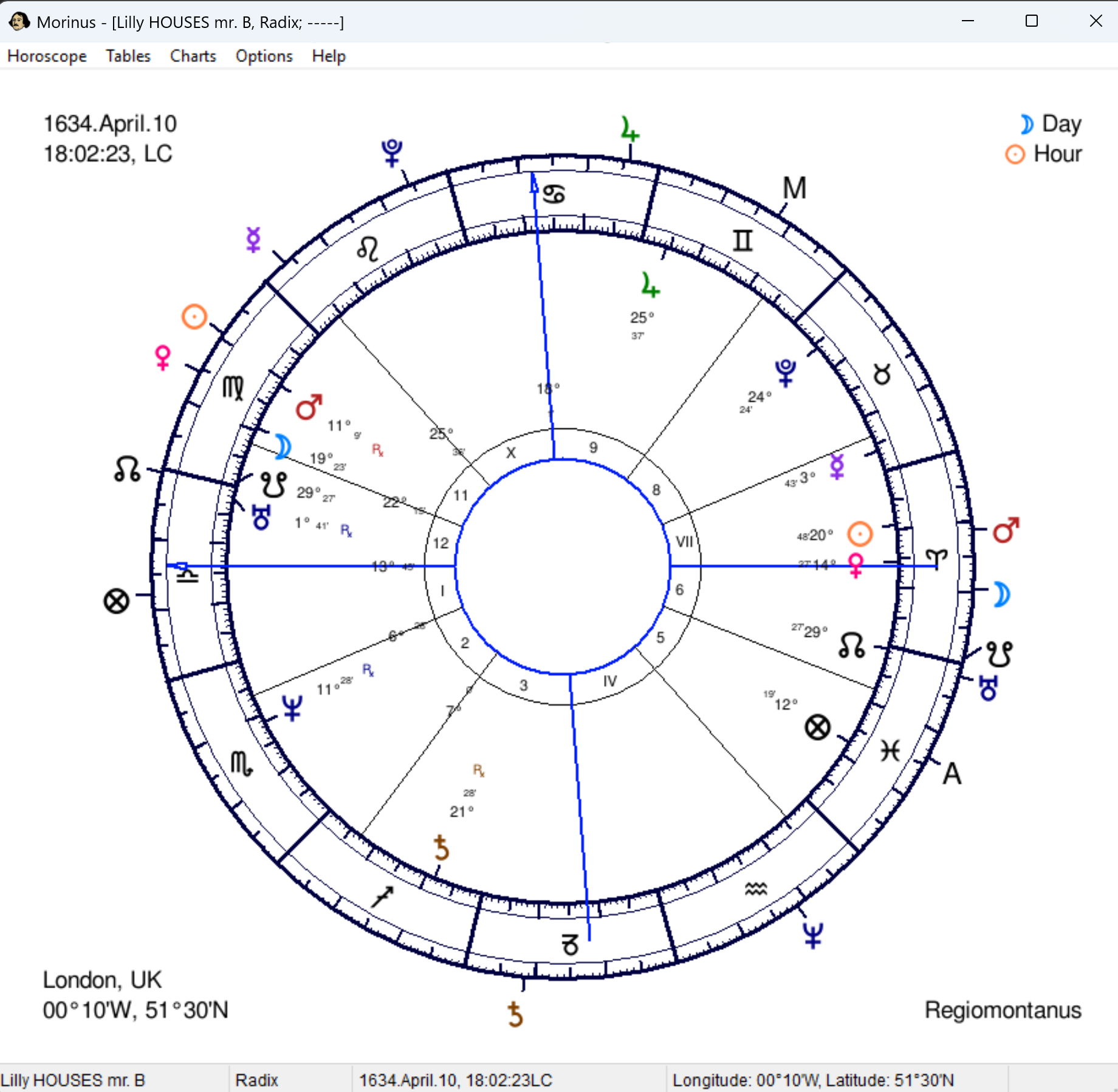
Let’s look at an example from Lilly. On page 219 of Christian Astrology, Lilly discusses a horary chart cast for his desire to purchase the Houses of Master B.
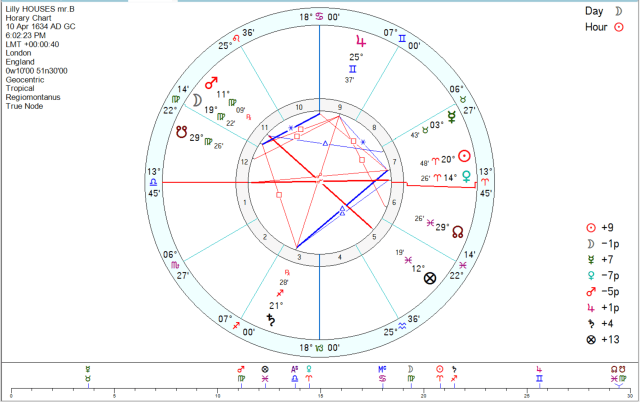
Lilly notes that the horary Asc (13 Libra 45′) is in the same degree as his natal Jupiter—a good omen.
Venus signifies Lilly, the querent. He assigns the Sun in the 7th to the seller, Master B.
The Sun receives Venus (Lilly) in his exaltation sign Aries, Venus conjoins the 7th cusp, and no other planets occupy the 7th so that there are no other buyers. The Sun also rules the 11th cusp, Lilly’s hopes and wishes in the matter.
Saturn rules the 4th cusp (the houses), and Venus (Lilly) applies mutually to trine Saturn, as does the Sun (Lilly’s hopes). Saturn also signifies Lilly because it beholds the Asc by whole-sign sextile and is the ruler of the Libra Asc by exaltation.
The Moon, which is translating the light of 7th-ruler Mars (the seller) to Saturn (Lilly, his hopes, the houses) by a spatial zodiacal SQUARE aspect, “(yet out of signs of long ascensions) did much facilitate the matter…” (C 220). Lilly realizes that a square from the Moon to Saturn would do much to hinder his buying the houses, but such a square in signs of long ascension would act more like a temporal trine and increase his chances of getting the houses. Lilly must also have regarded the Moon and Saturn in this chart as being reasonably well fortified and free of serious affliction to be able to act favorably on his behalf.
Looking at the speculum in Janus 6 software, we see:
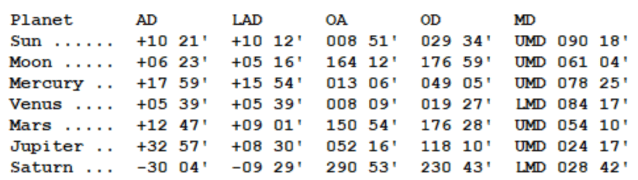
The column ‘OA’ gives the Oblique Ascension for each planet, that is, the degree on the Celestial Equator that rises simultaneously with the planet. The Moon’s OA is 164:12, and Saturn’s is 290:53. Thus, temporally the Moon and Saturn are separated by 126:41 degrees of OA along the equator, which is quite close to the number of degrees in a trine. Spatially, the Moon and Saturn are separated by 92:06 degrees along the ecliptic circle, a square aspect. The next table from Janus 6 shows the rising times of the signs in this chart, expressed in degrees of Right Ascension crossing the Midheaven as the signs rise:
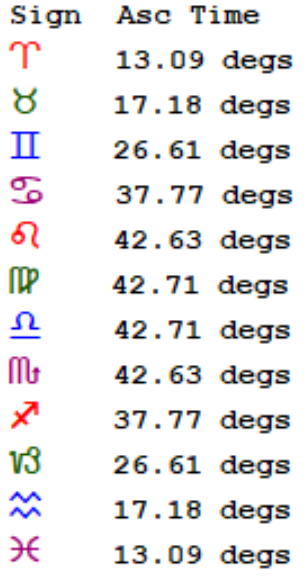
The Moon lies in Virgo, and Saturn lies in Sagittarius. The signs Virgo, Libra, Scorpio, and Sagittarius are all of long ascension. The average rate is 30 degrees per sign, and each of these signs takes substantially more than 30 degrees of R.A. per sign to rise.
The roll of antiscia in this chart is quite striking. Here is Lilly’s horary with the antiscia around the outside of the wheel. Note how Venus (Lilly), Mars (Master B, the seller), and their antiscia are interacting in this horary.